IRR > 200%
Vendor unbundling & insourcing
- 3 applications insourced
- 5-year savings > $5MM
In-house software that displaces expensive legacy and high-risk vendors.
Advising boards, executives, and builders on AI — value creation, governance, training, and agentic systems — grounded in hands-on building.
I help organizations turn AI capability into governed, measurable enterprise value — working across the board's oversight questions, the executive's value and allocation decisions, and the practitioner's reality of shipping AI. I don't only advise on AI; I build with it, from adaptive learning tools to the AI Engineering Value Model below.
How I operate with AI
I don't only advise on AI — I run my own work on the same discipline I recommend. The story behind it →
I don't count hours saved; I re-allocate freed capacity to the highest-leverage work — the discipline at the core of the value model.
I run AI like a P&L line: concentrated on the top use cases and reviewed like any other spend, not sprayed across everything.
I've delivered $45M+ in AI-enabled net revenue — with zero regulatory findings — and applied the model across the enterprise use cases below. I still build myself, prototyping real products end to end (ReadinessIQ, a chess trainer for my kids, this site). Execution is what makes the advice real.
I work across the frontier — Claude, Devin, Codex, Gemini, and more — matching the model to the task and orchestrating them in agentic workflows. That keeps my advice vendor-neutral and current as the tools change month to month.
Judgment, governance, and taste stay in the loop; agents do the heavy lifting.
Advisory areas
A rigorous model for turning AI engineering uplift into enterprise value — capacity, constraints, and the allocation decision that separates a modeled gain from booked value.
AI oversight, responsible-AI frameworks, and the questions boards should be asking — informed by standards-body work at FDX and the Data & Trust Alliance.
AI literacy and working sessions for boards and leadership teams — building the fluency to govern AI and turn it into advantage.
Assurance, controls, and deployment as agentic software and reduced human-in-the-loop reshape how work gets done.
Featured model — AI Engineering Value Model
Most AI-ROI math stops at an uplift number. The value is in what comes next — the capacity created, the constraints that gate it, and the allocation decision that turns freed hours into enterprise value.
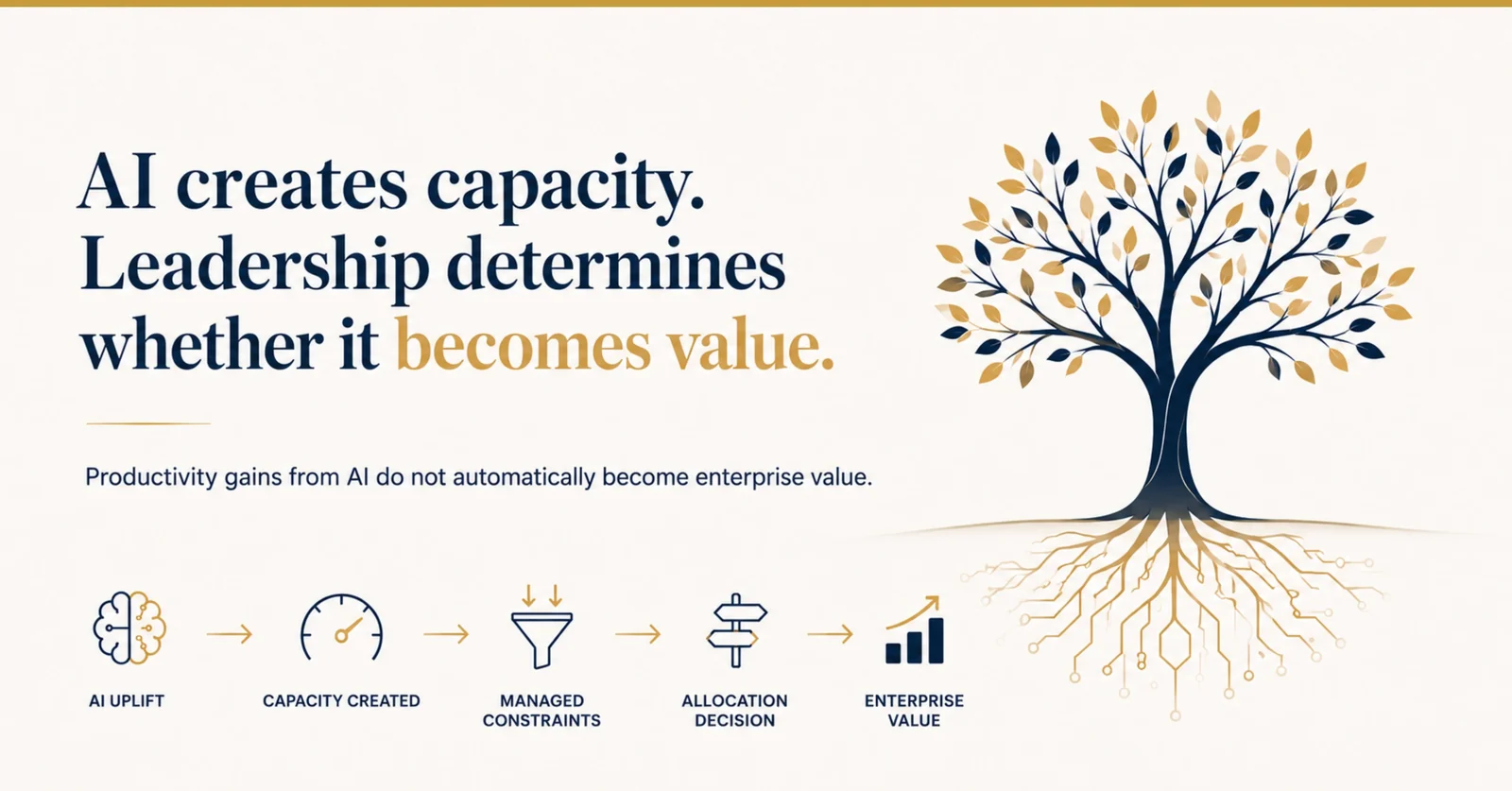
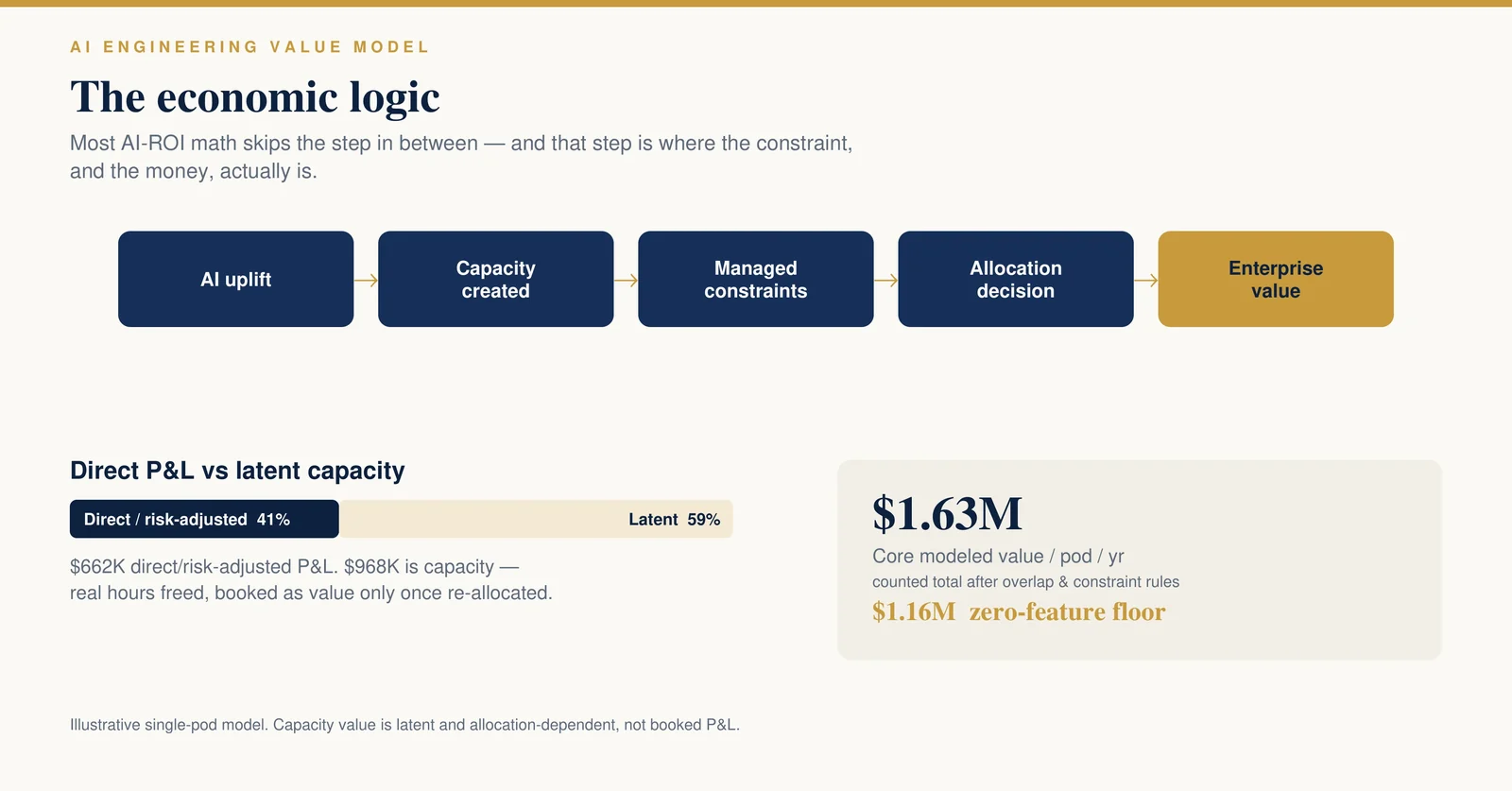
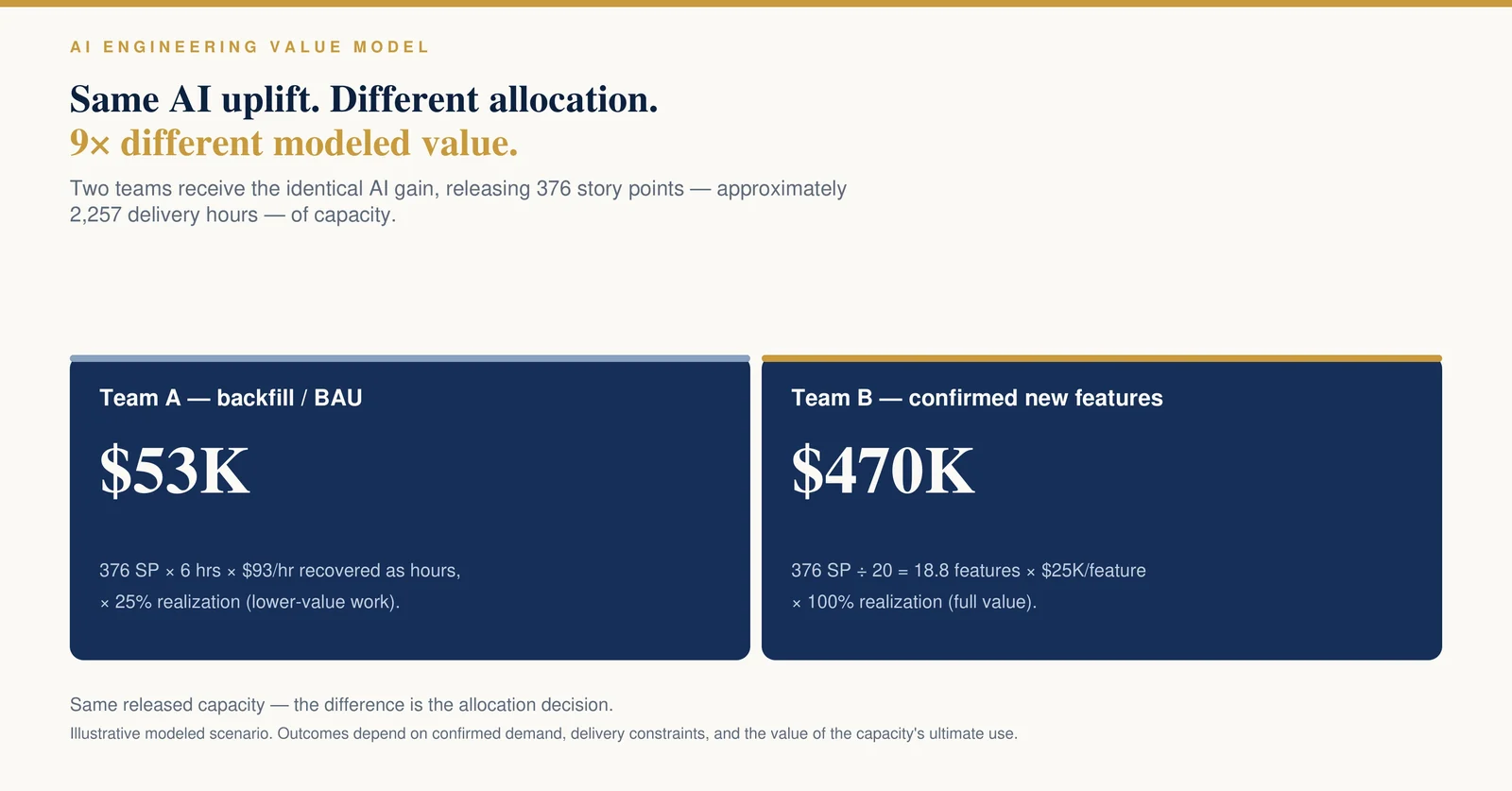
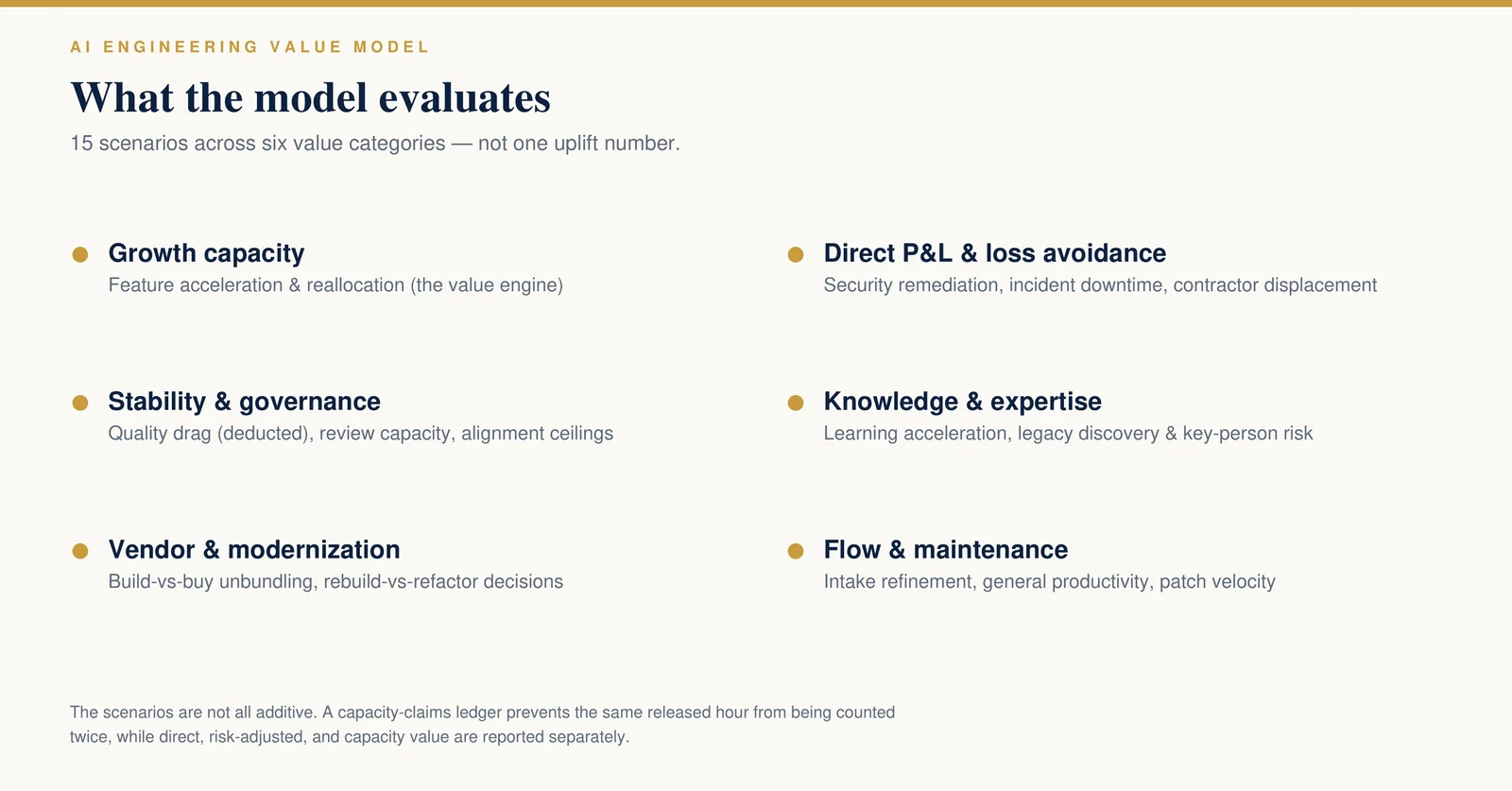
The model in five slides · View the full PDF →
Applied use cases
Where the model has been applied — from a single pod to the enterprise. Representative outcomes. Scroll for more →
IRR > 200%
In-house software that displaces expensive legacy and high-risk vendors.
$2.5MM / yr
Redirecting AI-freed capacity to high-value initiatives, not backfill.
−$180M tail risk
AI detection, prevention, and hardening in high-value targets.
> $10MM saved
Automating large-scale contract matters (e.g., LIBOR → SOFR).
> $20MM saved
NLP and computer vision to defensibly test full populations.
> $5MM saved
Smart, compliant self-service that scales cheaper than staff.
Representative outcomes from applied use cases; results depend on scope, constraints, and the allocation of released capacity.
Proof points
The technical evidence behind these claims — build notes and evaluations — is written for CIOs and CAIOs in Applied AI and Discovery, on Substack.
Applied AI Systems Lab
The evidence beneath the advice. Each prototype leads with the business question and the control point — then opens into a builder view with architecture, models, evaluation, human-in-the-loop controls, and what it can't do yet.
AI Engineering Value Diagnostic
I open a small number of executive calibration sessions for leaders who own AI investment, product growth, transformation, operating performance, or technology. The diagnostic calibrates all 15 scenarios to your organization, identifies the binding constraint, and develops a defensible, risk-adjusted value range.
Board service, advisory, speaking, or executive AI education — start a conversation.