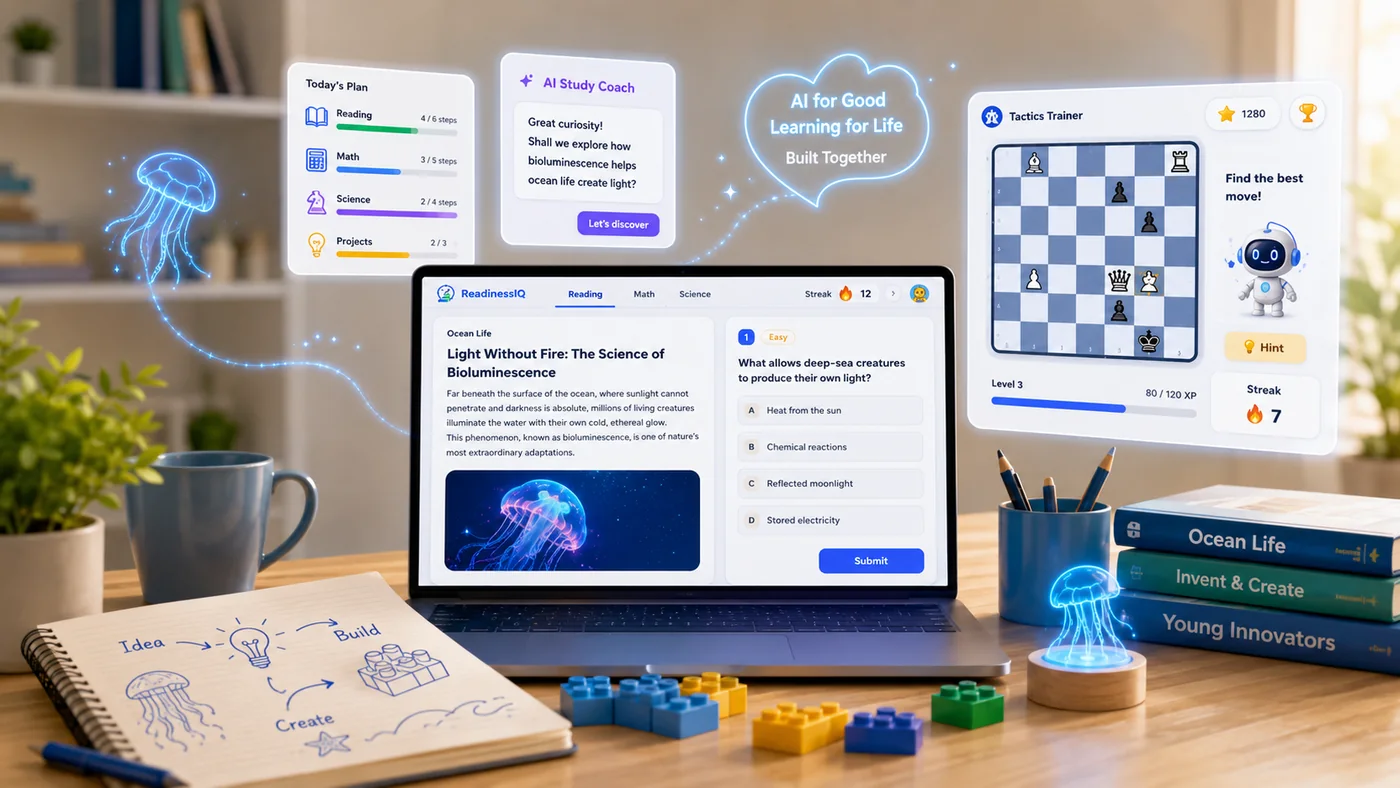
Originally published on LinkedIn.
I often hear concern about what AI will mean for the future of education and work. Will kids stop thinking for themselves? Will they use AI to bypass learning rather than deepen it? Will technology make learning less human?
Those are fair questions. As both a parent and an educator, I think about them too.
But over the last few months, I have been exploring a different side of the conversation: whether AI can create more curiosity, more ownership, more humanity, and even more time spent learning with my kids.
It started, in part, because I was losing the battle to Roblox.
A while back, I bought one of those STEM project boxes for my boys. They genuinely enjoyed it. They opened the box, built the project, played with it for a few minutes, and then came the inevitable question: “Can we go back on Roblox?”
Ugh.
Around the same time, I suggested using AI to help with something and one of my boys immediately teased me:
“I’m not lazy, Dad. I don’t need AI.”
This caught me completely off guard given my enthusiasm for AI. Challenge accepted.
Over the weekend, I started thinking about whether I could involve my kids in AI without teaching them that it was simply a machine for producing answers — or just the response at the top of Google when they search for things. Could we recreate some of the build-play loop that makes games so engaging? Could we take an idea they cared about, turn it into something real, and hold their attention longer than a small weekend project?
The result has been two applications we built together: one focused on learning and one focused on gaming (chess).
To be clear, the learning application still feels a little like homework, so parental encouragement is required. AI has not solved everything, and they don’t quite have Spock’s enthusiasm for learning yet. But both projects have changed the way I think about AI and learning.
ReadinessIQ: More agency for parents
The first application became ReadinessIQ, an adaptive learning and practice platform with gamification.
The idea came from a frustration I had as a parent. My children already use sophisticated learning tools through school, and those systems provide scores, reports, and colorful indicators of progress. Yet I often found I still could not answer the questions I actually cared about.
What exact questions did my child miss? The categories were vague and lacked sample questions despite all their explanatory blurbs. Could I immediately start a targeted practice session around that gap? Was the same problem recurring over time? Could I monitor category growth as opposed to overall growth?
I also wanted more visibility into the content itself. Some reading passages felt disconnected from my kids’ interests or needs, and I wanted a way to review material before it was assigned. I had another practical question around reading development: how do I consistently recommend books that are age appropriate but still stretch them? I want them to read the fun books their friends are reading, but I also want to know what might challenge them next.
The existing tools were good at reporting performance. I wanted something that gave me more agency as a parent.
So I built the first version of ReadinessIQ over a weekend using Claude Code. AI supports problem-set and reading-passage generation, while the application gives me parental review, targeted learning sessions, performance history, and detailed visibility into missed questions.

Since then, I have added book recommendations, deeper analysis, and more gamification. I can ask one of my kids to complete a focused study session and then review exactly what they saw, how they responded, where they struggled, and what we may want to work on next. We can even try it together at home for a more discussion-driven approach.
That visibility matters to me not because I want to turn parenting into a dashboard. It matters because better information helps me have a better conversation with my child.
“Where did you get stuck?” is a much better discussion when I understand the problem they were actually trying to solve.
Chess Trainer: Building something that is yours
The second project started differently.
My oldest has recently become interested in chess and enjoys doing puzzles on ChessKid. I challenged him to help me come up with an application or game that he would actually want to use.
Unsurprisingly, he picked a game — and of course chess.
We talked about what he liked, how it should work, and what would make practice more fun. We jointly decided to emphasize puzzles and more intentional practice around tactical concepts.
From there, we built a Chess Trainer that uses Lichess data and Stockfish analysis to track progress and organize practice around forks, pins, discovered attacks, deflections, and other tactical patterns. We added characters, progression, streaks, rewards, parental views, and many of the bells and whistles a kid (and parents) expect from a game.
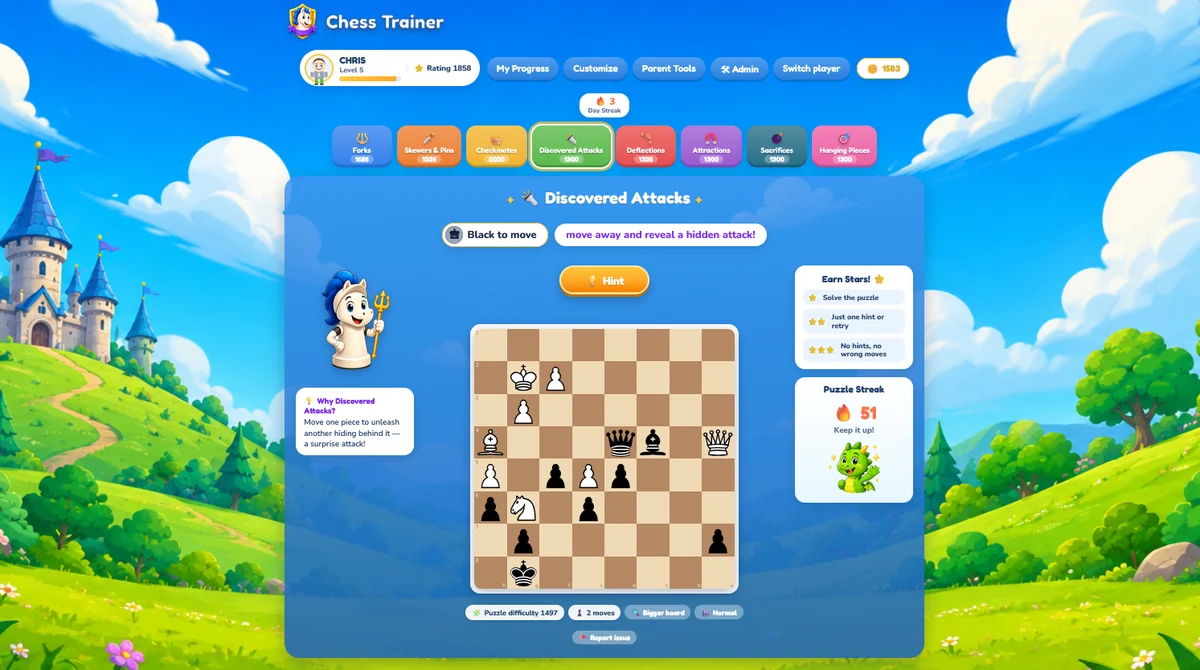
There are already excellent chess products for kids. ChessKid provides structured learning and puzzle tracking, and in many ways it is exactly where my children should be practicing.
But something interesting happened: my kids still wanted to use the one we built.
Not because every feature was better. It wasn’t.
They wanted to use it because it was theirs.
My son helped choose the idea. He had opinions about the interface. He tested puzzles. He told me when things were boring, confusing, or just not cool enough. He watched a rough concept become a functioning game and understood that his input had shaped the product.
The value was not simply the chess practice. The value was seeing an idea move from imagination to creation.
AI as the workshop, not the shortcut
A lot of the discussion about children and AI understandably starts with restriction: do not use AI to write your homework, do not let it think for you, and do not become dependent on a machine for answers.
Those are reasonable guardrails. I do not want my kids to treat AI as a substitute for effort or thought.
But I also do not want their primary mental model of AI to be “the thing people use to cheat” or, apparently, “the thing Dad uses because he is lazy.”
I want them to see AI as a workshop.
A place where an idea can become a prototype. A question can become an experiment. A game they imagine can become something they can actually play.
There is a scene in Inception where Ariadne begins to understand what she can create inside the dream world: “It’s pure creation.” That is the feeling I want my kids to experience.
What has surprised me most is that AI did not remove me from the learning process. In these projects, it brought me further into it. We had to talk about what to build, make choices, test ideas, troubleshoot problems, and decide what was actually useful or fun.
We created together, played together, and learned together.
And somewhere in the process, my kids got to experience the distance between “What if we made…” and “Look, it works” becoming dramatically shorter.
I think that build-play-learn loop may be one of the most interesting opportunities AI creates for the next generation. The technology can do more of the heavy lifting, but that does not mean the human part disappears. It may give us more room for curiosity, imagination, and creation.
For now, I am going to keep building with my kids and see where their ideas take us.
Even if I am still losing the long game to Roblox.