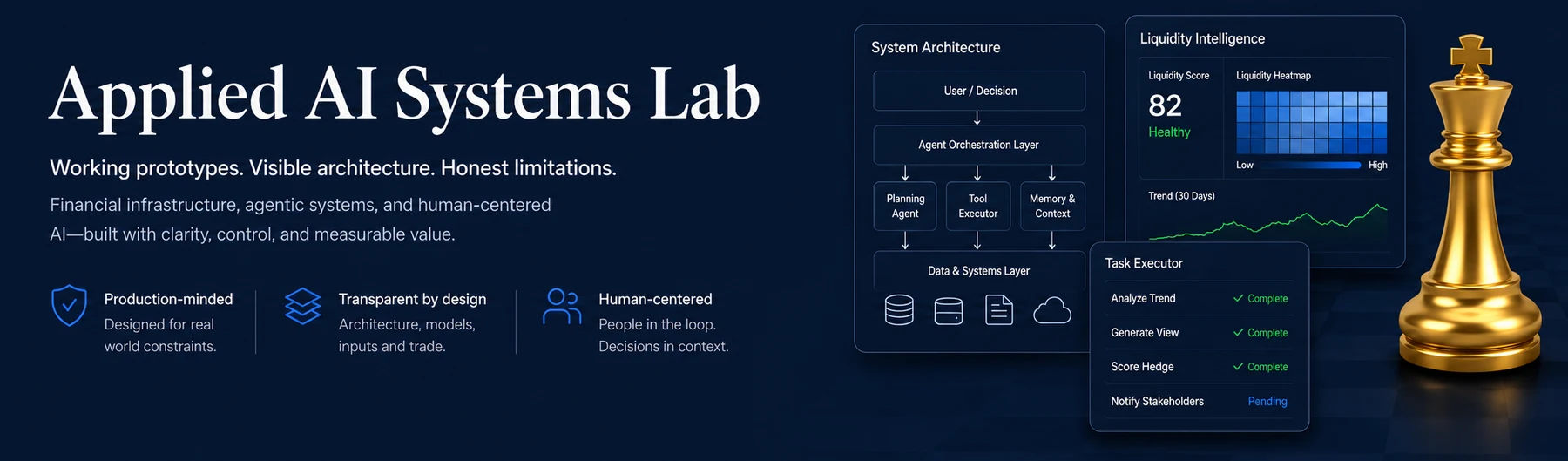
Liquidity Intelligence
The question
Can AI identify meaningful intraday liquidity movement and emerging funding risk without burying treasury teams in alerts?
The prototype
A monitoring workflow that combines payment-flow data, thresholds, anomaly detection, and AI-generated explanations for material changes.
What it demonstrates
Executive relevance
Earlier visibility, reduced monitoring effort, faster investigation, and better prioritization of liquidity events.
Control point
AI explains and prioritizes activity; treasury retains the decision and escalation authority.
Functional prototype · Synthetic / sample data
See how it works
- Architecture
- Event ingestion → time-series store → threshold and anomaly detection → LLM explanation layer → alert orchestration → human review queue.
- Models & tools
- Statistical anomaly detection generates the signal; a frontier LLM is used only to explain and rank material changes — deliberately not as the detector.
- Data sources
- Synthetic and sample payment-flow data; no production or customer data.
- Evaluation
- Precision and recall measured against seeded anomalies, plus an explicit alert-volume budget so 'more alerts' never counts as success.
- Human-in-the-loop
- Every alert lands in an analyst review queue; escalation and decision authority stay with treasury.
- Cost & usage
- Token spend metered per alert; the LLM is invoked only on material changes, which keeps cost proportional to signal, not volume.
- Known limitation
- Alert quality depends heavily on establishing institution-specific seasonal baselines. The prototype demonstrates the workflow but is not presented as a production liquidity-risk model.
- Lesson from building it
- The hard problem was never detection — it was suppression. Most of the work went into not alerting.