Originally posted on LinkedIn.
That is the risk when banks reject stablecoins and go all-in on tokenized deposits.
Banks are optimizing to protect the form of the deposit while potentially losing the customer relationship that creates the deposit in the first place.
Tokenized deposits solve a legitimate bank problem. They preserve the deposit claim, insurance, yield, and more of the economics surrounding the relationship.
But they do not automatically solve the customer’s problem.
Customers are not using stablecoins only to make payments. They also want portable dollar liquidity, collateral, 24/7 availability, cross-border access, treasury mobility, and participation in digital markets. A closed tokenized-deposit network may protect the bank’s balance sheet while giving the customer less reach than the stablecoin ecosystem they already use.
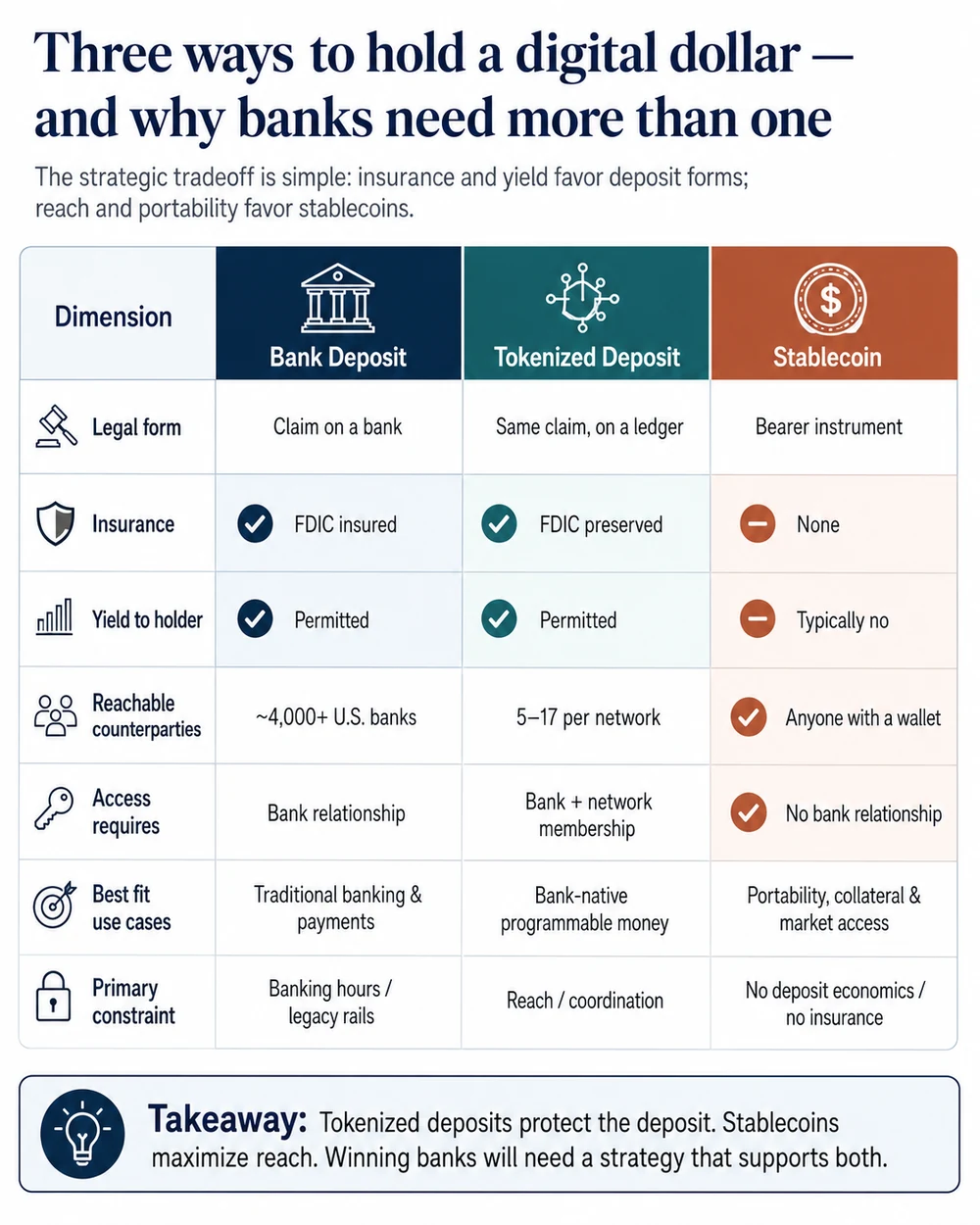
Recent models such as Open Standard’s OUSD and SoFi’s hybrid approach suggest the market is already moving beyond a simple stablecoin-versus-tokenized-deposit choice. Stablecoin models are beginning to share reserve economics with banks and distributors. Banks are exploring assets that can behave differently on- and off-platform.
The categories are beginning to converge, but the reach problem has not been solved. That is why I believe the winning strategy is optionality:
- Support tokenized deposits where bank-native, insured money is best.
- Support stablecoins where reach and portability matter.
- Use sweeps, orchestration, and partner networks to preserve deposits and yield across both.
A tokenized-deposit strategy protects the product. A multi-rail platform strategy protects the customer relationship.
The strategic question is not, “Which digital dollar wins?” It is: should banks issue one more instrument — or become the platform that helps clients use every instrument intelligently?
I’m also interested in the counterargument: can tokenized-deposit networks achieve sufficient reach quickly enough that banks do not need a stablecoin path — or is optionality now unavoidable?